Pack light, trim level, launch. A two-day river drift requires precision outfitting rather than casual packing. For a standard weekend overnight on moving flatwater, a tandem canoe carries two adults, shelter, sleep systems, water, cook kits, and emergency equipment. This payload typically adds 90 to 140 pounds to the hull, excluding the paddlers themselves. If this mass sits an inch too high or two feet too far forward, boat handling deteriorates immediately. A poorly outfitted canoe catches the wind, wallows through turns, and risks swampings on simple river obstacles.
Every piece of gear must earn its place on the bottom of the hull. Rivers with current speeds between 2 and 4 miles per hour leave little room to adjust mistakes once you clear the gravel bar. Setting up a canoe for self-supported weekend micro-adventures means treating the boat as a dynamic platform. Center of gravity, waterline trim, retention systems, and line management determine whether you arrive at camp dry or spend the evening drying sleeping bags over green wood smoke.
Balancing Fore and Aft Canoe Hull Trim
Load the hull to achieve a neutral trim or a slight stern bias. In a flatwater river context, a neutral trim means the boat sits completely parallel to the water surface, drawing an equal depth of water from stem to stern. If your bow sits lower than your stern, the canoe tends to follow the bow into current differentials, an effect known as bow-steering. Bow-steering makes the craft twitchy and forces the bow paddler to fight every eddy line. A stern trimmed roughly 1 to 2 inches deeper than the bow provides predictable tracking while keeping the bow buoyant over small standing waves and riffles.
Account for uneven paddler weights before loading dry bags. If the stern paddler weighs 210 pounds and the bow paddler weighs 145 pounds, the hull already carries a 65-pound stern bias without gear. To neutralize this differential, place the heaviest items, such as the water jugs and food barrels, directly forward of the center carrying yoke. If the paddler weights are reversed, with a heavier bow paddler, shove the dense gear back behind the center yoke toward the stern thwart.
Pack everything low. Every pound stowed above the gunwales raises the center of gravity and degrades the canoe's secondary stability. Place dense equipment, such as tools, canned goods, water, and cook gear, flat on the bottom planks along the keel line. Bulky, lightweight gear, including synthetic sleeping bags, down quilts, and clothing rolls, can rest higher in the hull. Keep the boat symmetrical side to side; an off-center list of even 1 inch causes significant paddler fatigue over a 15-mile float.
| Hull Zone | Equipment Assigned | Weight Range | Trim Purpose |
|---|---|---|---|
| Bow Section (Forward of front seat) | Throw bag, spare paddle, day dry bag | 8 to 12 pounds | Keeps bow light to rise over waves |
| Center Forward (Yoke to bow thwart) | Water containers, heavy dry food barrel | 35 to 55 pounds | Offsets stern paddler weight |
| Center Aft (Yoke to stern thwart) | Camp gear, tents, cookware | 30 to 45 pounds | Secures mass over deepest draft |
| Stern Section (Behind stern seat) | Bilge pump, sponge, river shoes | 4 to 7 pounds | Prevents stern pinning and tail-drag |
Lashing Barrels and Dry Bags Safely to Thwarts
Secure all cargo against total loss during a capsize without creating an entanglement death trap. On flatwater rivers, paddlers often make one of two critical errors: leaving gear completely loose or cinching it down with complex knots that cannot be cleared in an emergency. Loose gear floats downstream or sinks to the bottom in an upset. Rigidly lashed gear traps water inside an overturned hull, making a canoe rescue exceptionally heavy and difficult in moving current.
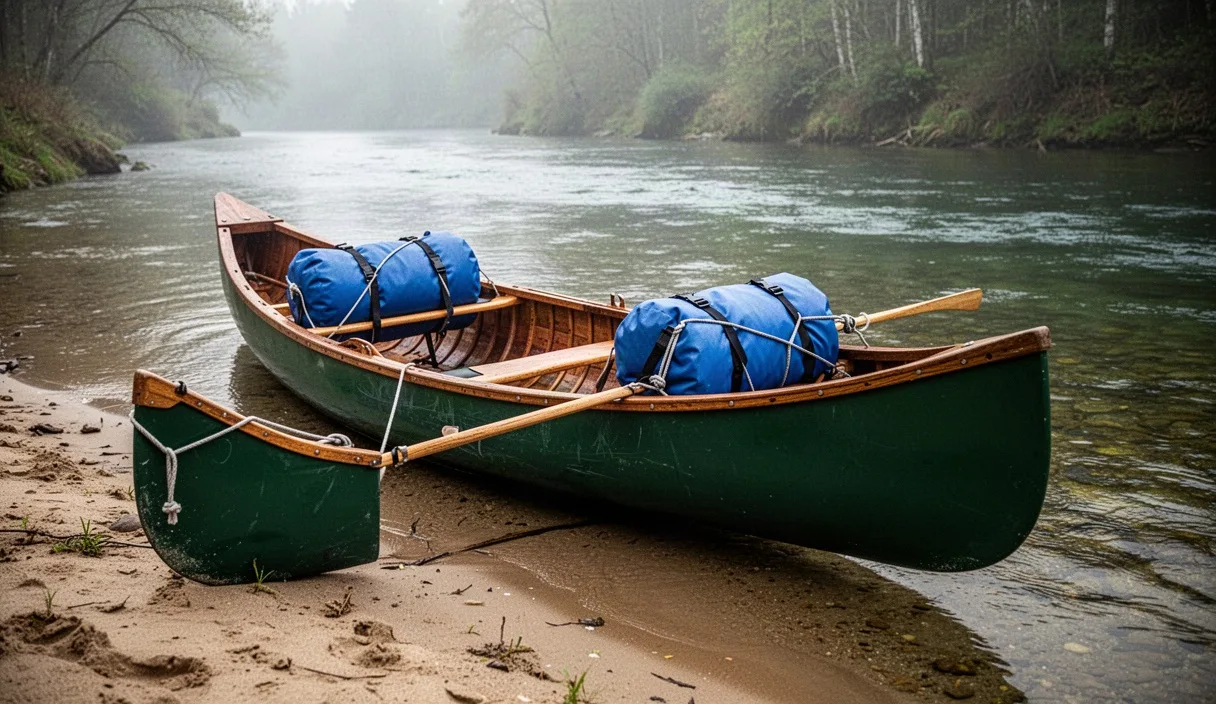
Use 1-inch cam straps or heavy tubular webbing instead of elastic bungee cords. Bungee cords stretch under hydrostatic pressure, allowing bags to shift, wedge under seats, or break free entirely. Fasten blue polyethylene barrels (30-liter or 60-liter drums) and vinyl dry bags to the bottom of the hull by threading straps through the factory-installed tie-down loops or around structural ash thwarts. Keep the barrels oriented horizontally along the keel line to reduce wind exposure.
Rig your lashings flush below the gunwale line. Run a continuous keeper line or daisy-chained strap through the handles of each bag, anchoring the run back to a central thwart with a quick-release knot, such as a highwayman hitch or a cam buckle. Do not clip gear directly to canoe seats with locking metal carabiners if current is running faster than walking pace. A carabiner clipped directly to a seat frame can snag a rescue rope, a foot, or an underwater branch during a swim, turning an inconvenient dump into a severe entrapment hazard.
- Use water-tight poly barrels: Choose gasket-sealed barrels for crush-sensitive items, camp stoves, and dry food stocks.
- Purge excess air from dry bags: Roll vinyl dry bags a minimum of three tight turns, kneeling on the bag to expel air before clipping buckles, unless floating an open hull without flotation blocks.
- Anchor painters properly: Keep 30-foot, 3/8-inch floating polypropylene painter lines coiled neatly on the bow and stern decks under shock cords, ready for deployment without tangling.
Reading River Hydrology, Eddies, and Deadfall Strainers
Flatwater river sections regularly conceal dynamic hazards beneath placid surfaces. Water moves fastest in the deepest channel, typically located along the outside curve of a river bend. This zone, called the thalweg, carries the bulk of the river volume. As the current rounds the bend, centrifugal force pushes the water against the outside bank, often undercutting trees and creating sweepers. Steer toward the slower, inside radius of river bends to keep your boat clear of undercut roots and unstable gravel banks.
Read surface patterns to identify submerged obstacles. A downstream "V" pointing down the river indicates clean, deep water passing between two submerged obstructions. Enter at the wide mouth of the V and ride through the center. Conversely, an upstream "V" points upriver toward you and marks a submerged rock, piling, or shallow gravel bar directly below the apex. When you see an upstream V, adjust your ferry angle early to clear the obstacle on either side by at least half a boat length.
Treat deadfall trees and root balls as lethal strainers. Water flows freely through the branches of a fallen tree, but solid objects, including boats and paddlers, are pinned against the wood by hundreds of pounds of continuous hydraulic pressure. If a river bend reveals a down tree spanning part of the channel, execute a back-ferry immediately:
- Angle the canoe at 30 to 45 degrees relative to the oncoming current, pointing the stern away from the hazard.
- Both paddlers execute smooth, powerful backstrokes to pull the boat across the river flow rather than fighting downstream momentum.
- Maintain eye contact with the hazard, holding the ferry angle constant until the boat clears the lateral line of the strainer.
- Turn the bow back downstream into the clean tongue of the current once clearance is secured.
Eddies form behind mid-stream boulders, bridge piers, and sharp shoreline projections. In these pockets, water stops or circulates upstream toward the obstacle. Use eddies to rest, scout downstream sections, or adjust shifting packs. To cross the shear line separating downstream current from an eddy, drive the bow firmly across the eddy line and lean slightly into the turn to let the counter-current catch the hull bottom rather than flipping the upstream gunwale.
Rigging Portages Around Mill Dams and Low Bridges
Scout every artificial structure from a safe distance upstream. Low-head mill dams, often called drowning machines, look harmless from above because they appear as a flat horizon line spanning the water. The drop may only be 3 to 6 feet, but the hydraulic boiling back toward the face of the dam creates a submerged re-circulating current that traps and drowns swimmers regardless of life jacket buoyancy. Low clearance bridges present a similar crushing risk during high spring runoffs. Locate the portage exit sign or identify an accessible bank at least 150 feet upstream of the hazard.
Rig your canoe for fast, single-lift portages before reaching the take-out bank. If gear is loose, portaging takes three trips back and forth, wasting energy and daylight. With proper outfitting, portaging requires two distinct jobs: one paddler carries the stripped canoe on the center yoke, while the other transports the balanced barrel pack and dry bags. Fit the center carrying yoke with dense closed-cell foam pads to protect your shoulders from raw pressure points over long trails.
Manage painters and loose gear before hoisting the boat. Unclip spare paddles and strap them flat along the ribs inside the hull using hook-and-loop wraps. Coil bow and stern painter lines tightly into their deck loops so they cannot drop down, loop around boots, or catch on brush along the trail. Never drag a composite, Kevlar, or wooden hull over concrete dam abutments or angular rip-rap stone; carry the boat clear of obstacles to prevent structural gouges or puncture damage to gel coats and outer laminates.
Riverbank Leave-No-Trace Camp Setup Protocols
Select your campsite on durable surfaces located away from flash-flood corridors. Exposed gravel bars and sand islands make excellent low-impact camp locations, but they present specific overnight risks. River levels can fluctuate by 2 or 3 vertical feet overnight due to localized rainfall miles upstream or municipal dam releases. Pitch shelters on high, dry ground well above the line of fresh flotsam, dried river foam, and drift wood, which shows the most recent high-water mark.
Secure the canoe high and dry the moment you land. Never leave an unloaded canoe resting half in the water overnight, even on a flat river. A light current or wake can float the boat free, leaving you stranded. Pull the hull completely onto the bank, flip it upside down to prevent it from filling with rain, and tie a painter line to a mature tree using a bowline knot or a secure round turn and two half-hitches.
Human waste disposal requires strict discipline along riparian corridors. In high-use river valleys, shallow soil depths and high water tables prevent traditional cat-holes from processing pathogens safely. Pack a dedicated solid-waste containment system, such as a clean-waste bag kit or an airtight PVC waste tube, commonly called a groover. If cat-holes are permitted by local river authorities, dig them at least 200 feet from the high-water line, 6 to 8 inches deep in organic soil, and pack out all used toilet paper in sealed plastic bags.
Use a portable fire pan if you choose to build a small campfire on gravel bars. Fire pans prevent charcoal and scorched rock marks from permanently disfiguring riverbanks. Burn only dead and down wood smaller than your wrist, and scatter the cool ashes into the main river current the following morning before shoving off. Pack out every scrap of food, foil, and packaging. River wildlife quickly habituates to campsites where bacon grease or freeze-dried food remnants are washed into the shore current.
Common Mistakes
- Over-tightening straps across thin thwarts: Cranking heavy ratchet straps around lightweight ash cross-thwarts splits the wood along the grain. Use hand-tensioned cam straps only.
- Stowing heavy items in the boat ends: Placing heavy cast-iron cookware or full water bladders in the far bow or stern increases the rotational inertia of the canoe, making turning slow and awkward.
- Letting lines dangle in the water: A dragging painter or strap will eventually catch on underwater deadfall, anchoring the boat abruptly in current and rolling it over instantly.
- Neglecting hull inspection before departure: Leaving the launch site without checking skid plates, gunwale rivets, and seat fasteners leads to structural failure miles away from road access.
- Misjudging bridge clearance: Attempting to float under a low bridge without stopping to check for floating drift jammed against upstream pilings risks a catastrophic boat pin.
Next Steps for Weekend Launch
Assemble your kit 48 hours before departure. Lay all equipment on a tarp next to the canoe in your driveway to perform a dry-run weight distribution check. Fill your water storage containers, load the barrels, and practice picking up each bag to assess its balance. Pack a separate emergency ditch bag containing a first-aid kit, waterproof headlamps, a fire starter, space blankets, and a spare layer of synthetic wool, and position it where it can be reached from the stern seat within three seconds.
Check the real-time stream gauges managed by water authorities or hydrological surveys for your target river run. Note the flow rate in cubic feet per second (cfs) and compare it against historical averages. If the river runs abnormally high after heavy rain, flatwater hazards multiply rapidly, deadfall strainers become unavoidable, and portages wash out. If you lack river-reading experience or self-rescue skills in moving currents, register for an accredited moving water safety clinic through an organization like the American Canoe Association before venturing onto unfamiliar waters.