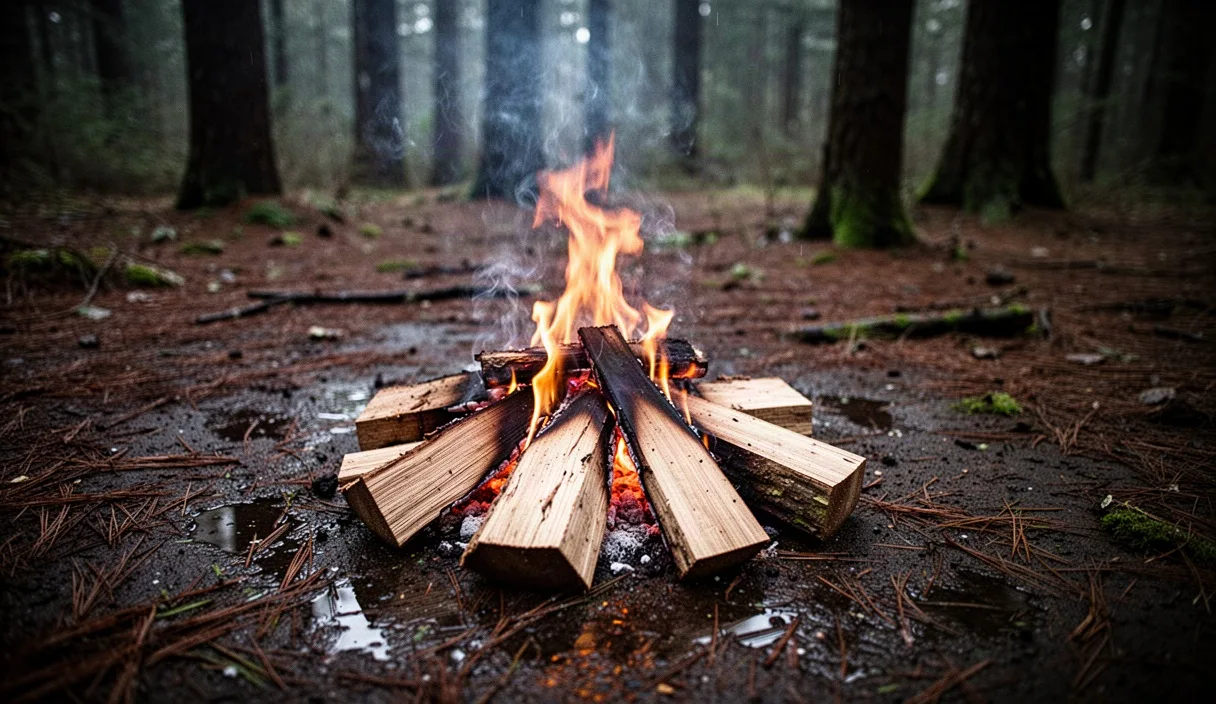
Water kills friction and cools combustion. In a drenched spruce or pine forest, surface moisture covers every fallen branch, needle, and patch of moss. Survival depends on bypassing that wet perimeter to reach the resin and dry fibers sealed inside the timber.
Coniferous forests hold an advantage over hardwood stands during prolonged storms. Evergreens produce volatile hydrocarbons in the form of resin, which repels liquid water and ignites at low flash points. By combining species identification, mechanical wood processing, and ground insulation, you can generate self-sustaining flames in continuous rain using only a knife and a spark generator.
Finding Dry Fatwood in Dead Conifer Stumps
Look for old pine stumps rotted down to a weathered core. When a pine tree dies, gravity pulls the tree's natural terpene-rich resin down into the taproot and root collar before the upper trunk rots away. Decades later, the soft outer sapwood decays, leaving behind an intensely saturated, rot-resistant core known as fatwood or lighterknot.
Kick or strike suspect stumps with a heavy boot or a branch. If the stump crumbles into dark, sponge-like soil, move on. If your boot strikes a rock-hard pillar that rings with a solid thud, you have found resin-soaked heartwood. Use your knife to shave a test sliver from the dense center. Pure fatwood exhibits three specific traits:
- Visual opacity: The wood looks dark amber, reddish-brown, or translucent like hardened honey.
- Aroma: A sharp, chemical smell of turpentine or concentrated pine sol rises immediately upon cutting.
- Texture: Shavings feel waxy, greasy, and stiff rather than fibrous and wet.
Harvest fatwood by chopping or splitting vertical slabs from the core using a fixed-blade knife and a hardwood baton. Collect a chunk the size of your fist. Because fatwood is bound by crystallized resin, rain cannot soak through its surface. Even if you pull a piece from running mud, you can scrape away the surface liquid with the spine of your knife and immediately access flammable material inside.
Harvesting Standing Dead Branches in Steady Rain
Dead wood resting on the forest floor acts like a sponge, absorbing groundwater and rainfall via capillary action. Never gather fuel from the ground in wet weather. Direct your focus entirely to standing trees with dead lower branches, often shielded under the live, dense canopy of mature white pines, Douglas firs, or Norway spruces.
Dense conifer canopies act as natural umbrellas, keeping the lower trunk zones relatively sheltered. Look for "squaw wood", the small dead twigs and branches still attached to the lowest two to six feet of a tree trunk. These branches died off as the tree grew taller and shaded them out, leaving them suspended above ground moisture and dried by circulating wind.
Test branches by snapping them with your hands instead of cutting:
- Select branches close to the trunk where shelter from falling rain is greatest.
- Bend a branch backward toward the trunk. A wet, green, or rotten stick bends silently without breaking, or tears with a stringy fracture.
- Listen for a crisp, audible crack. If the wood snaps clean and sounds like a breaking dry bone, the core is dry enough for your fuel progression.
Sort your harvested standing wood into four distinct piles before striking any spark. Keep the piles covered with a bark slab, rain poncho, or pack fly:
| Fuel Grade | Thickness | Quantity Needed | Primary Function |
|---|---|---|---|
| Matchstick | 1 mm to 3 mm | Two large double-handfuls | Catches the initial spark or ember directly from tinder. |
| Pencil-sized | 5 mm to 8 mm | Two large double-handfuls | Establishes early heat and bridges tinder to fuel logs. |
| Thumb-sized | 15 mm to 25 mm | Three armfuls | Generates the first persistent bed of red coals. |
| Wrist-sized | 40 mm to 70 mm | Five to eight logs | Sustains long-term heat and dries green wood. |
Batoning Damp Wood to Reach Bone-Dry Heartwood
Standing dead branches thicker than two inches often have a wet outer ring of dead sapwood, especially during prolonged storms. To access the dry wood inside, use your knife and a wooden club to split the round timber down into flat billets. This technique, called batoning, exposes the heartwood, which remains shielded from water even if the bark is slick.
Select a straight, knot-free section of standing dead conifer between three and five inches in diameter, roughly 12 to 16 inches long. Cut a sturdy hardwood club from a green branch to serve as your baton, aiming for an implement roughly two inches thick and 14 inches long. Avoid using rocks or metal, which will deform the knife spine and snap the blade.
Position the log upright on a solid, level surface. Place the center of your fixed-blade knife edge across the center of the log end, keeping the blade horizontal. Strike the spine of the knife directly behind the cutting edge with your baton to seat the blade into the grain. Continue striking the portion of the spine that protrudes past the wood until the log splits cleanly in half.
Split the resulting halves into quarters, and the quarters into eighths. Inspect the innermost edge of each triangular split piece. You will see a distinct color change: the outer rings are dark, cool, and damp, while the center grain is lighter, dusty, and dry to the touch. Shave off and discard the wet sapwood and bark strips, preserving only the dry heartwood wedges for your kindling and fire structure.
Feather Stick Geometry for Rapid Ignition
Feather sticks turn split heartwood into high-surface-area tinder that catches sparks directly from a ferrocerium rod. When carving, the goal is not to whittle off wood chips, but to cut long, paper-thin ribbons of dry wood that remain anchored to a rigid central stick. This structure creates an integrated ladder of fuel that permits upward airflow between micro-layers of wood.
Choose an eighth-split heartwood stick with straight, parallel grain lines. Anchor the butt of the stick against a stable stump, log, or your knee while seated, angling the stick downward away from your torso. Lock your knife arm at the wrist and elbow, using movement from your torso and shoulder to regulate cutting pressure. This rigid mechanics prevents sudden slips and keeps the cut depth consistent.
Control blade geometry to govern curl thickness:
- Blade angle: Tilt the bevel slightly off-perpendicular, around 15 to 20 degrees relative to the wood face, peeling rather than scraping.
- Curl thickness: Target shavings translucent enough to read newsprint through. Thin curls ignite with a low-temperature spark; thick chips require sustained open flame.
- Even spacing: Stop each stroke roughly a quarter-inch before the bottom of the stick. Rotate the stick 90 degrees after three strokes to create curls that radiate outward like petals around a stem.
Carve at least three full feather sticks with tight, fuzzy plumes before attempting ignition. Create an additional pile of loose, needle-thin shavings scraped directly off the heartwood with the 90-degree spine of your knife. The spine scrapings act as flash-tinder, catching molten sparks from your ferro rod and igniting the thin feather curls, which in turn catch the heavier wooden stalk.
Building a Log Raft Platform to Counter Mud and Snow
Never build a fire directly on wet forest soil, duff, or snow. The rising heat of your initial flame liquefies snow and draws moisture out of sodden ground, creating steam that snuffs out young embers from below. A log raft platform isolates the fire from the heat-sink effect of saturated ground and ensures oxygen reaches the bottom of the fuel stack.
Gather green, damp, or non-combustible logs between two and four inches in diameter, cut to lengths of roughly 18 inches. Lay six to eight of these logs side by side on the cleared ground to form a flat floor. On top of this base, lay a second layer of logs running perpendicular to the first. This double-layer crisscross grid creates a stable, elevated floor with air channels underneath.
Cap the top layer of the platform with dry bark peeled from dead conifers or a thin skin of flat split pieces. This cap seals gaps between the platform logs, preventing fragile sparks, matchstick kindling, and coal clusters from falling between wet wood into the mud beneath.
Anchor your prepared feather sticks in the center of the platform. Shelter the setup with your body by positioning your back against the prevailing wind and precipitation. Once lit, the log platform slowly chars from the top down, giving the fire core hours to build an expansive coal base before ground dampness can exert any cooling effect.
Common Mistakes
Most field failures trace back to predictable errors in preparation and patience:
- Rushing the spark: Striking a spark before accumulating all necessary fuel grades forces you to search for twigs while the fragile ember burns out.
- Using ground-contact wood: Gathering deadfall from the forest floor introduces wood with high internal moisture content that smothers low-heat embers.
- Skipping the thermal base: Laying kindling on wet soil or snow, which cools ignition temperatures through steam production.
- Carving thick feather curls: Shaving curls thicker than cardstock, which shed sparks instead of catching them.
- Smothering early flame: Dropping dense fuel horizontally across young flames instead of leaning pieces upright in a tepee or lean-to shape to permit natural chimney draft.
Practical Next Steps
Take your tools into a controlled setting before relying on these skills in remote conditions. Pack a fixed-blade bushcraft knife, a half-inch thick ferrocerium rod, and a folding saw to a local wooded area after an extended rainstorm. Practice locating standing dead wood and harvesting three distinct tree-attached branches under a wet canopy.
Set a timer for 20 minutes. Force yourself to split an eight-inch log down to heartwood, carve two functional feather sticks, and build an elevated platform before throwing a single spark. Master the physical mechanics of the downward knife slice to produce paper-thin curls repeatedly. If you plan remote, multi-day wilderness expeditions in mountain terrain or freezing climates, seek structured field instruction from certified wilderness survival guides to calibrate your margin of safety.