Clean water dictates trail survival. Choosing between a mechanical gravity system and chemical purification comes down to group size, water turbidity, ambient temperature, and biological risk profiles. Mechanical hollow-fiber filters remove protozoan cysts and bacteria immediately through size exclusion, providing instant hydration for thirsty hikers. Chemical treatments, specifically chlorine dioxide, destroy viruses and kill pathogens through oxidation without adding mechanical bulk, but they require strict contact times before the water is safe to drink.
Relying solely on one method creates vulnerabilities in remote terrain. A cracked hollow-fiber core leaves a hiker without options, while chemical treatments struggle in silty, organic-heavy runoff where oxidizers get depleted before neutralizing microbes. Understanding the operational limits of both systems allows backcountry travelers to design reliable hydration setups. The following breakdown covers flow mechanics, dosing protocols, sediment mitigation, sub-freezing management, and fail-safe redundancy for field expeditions.
Hollow-Fiber Filtration Flow Rates and Pore Sizes
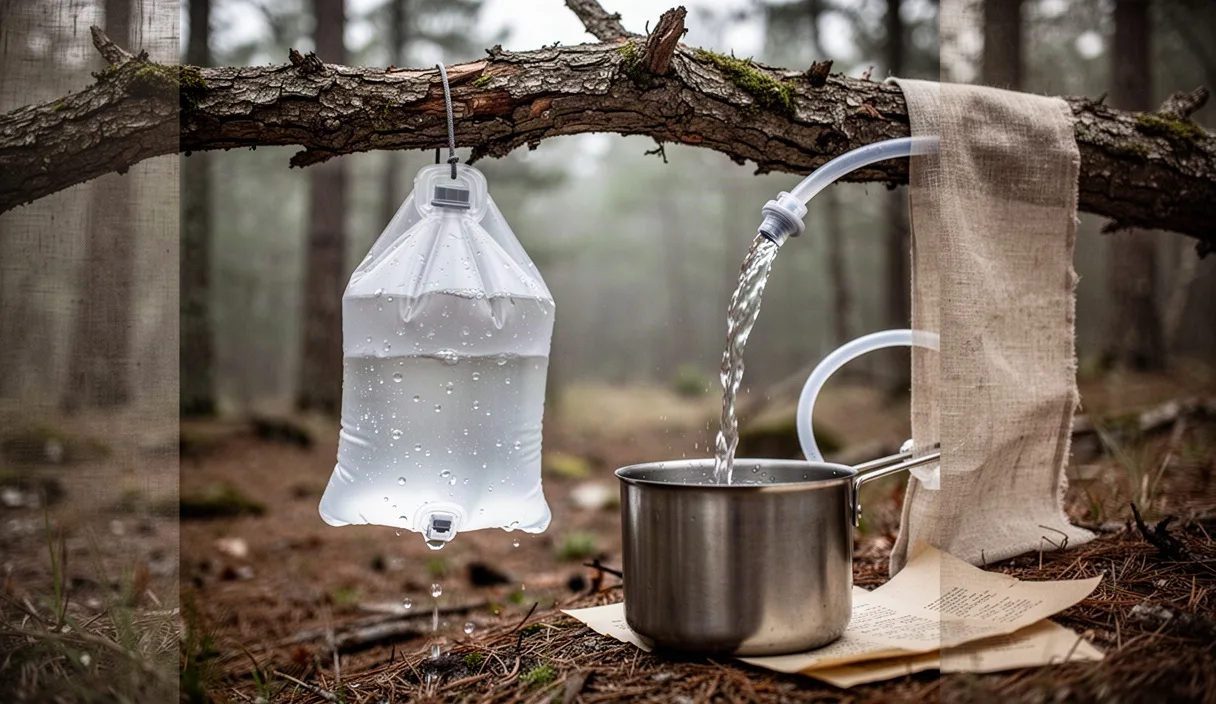
Gravity micro-filters operate via bundles of porous, hollow straw-like fibers. Water flows from a dirty reservoir bag, enters the microscopic pores in the walls of the fibers under hydrostatic pressure, and exits through the open bore as potable filtrate. Most commercial units, including systems from Katadyn and Platypus, use an absolute pore size of 0.1 or 0.2 microns. This physical barrier blocks waterborne protozoa such as Giardia lamblia (8 to 14 microns) and Cryptosporidium parvum (4 to 6 microns), as well as pathogenic bacteria like Escherichia coli (0.5 to 2 microns) and Campylobacter jejuni (0.2 to 0.8 microns). These fibers do not capture viruses, which typically measure between 0.02 and 0.4 microns.
Flow rates depend directly on pore size, membrane surface area, and head pressure. Head pressure is determined by the vertical distance between the hanging dirty reservoir and the clean catch container. Suspending a four-liter dirty reservoir 1.5 meters above the ground yields roughly 0.15 bar of pressure. With clean water and an unsoiled filter, this configuration produces between 1.2 and 1.8 liters per minute for a 0.2-micron cartridge. A 0.1-micron cartridge offers a tighter physical safety margin against smaller bacterial variants, but baseline flow rates drop to roughly 0.6 to 1.1 liters per minute under identical head pressure.
| System Metric | 0.2-Micron Hollow Fiber | 0.1-Micron Hollow Fiber | Chlorine Dioxide (Liquid/Tabs) |
|---|---|---|---|
| Target Pathogens | Bacteria, Protozoa | Bacteria, Protozoa | Bacteria, Protozoa, Viruses |
| Flow Rate / Speed | 1.2 to 1.8 L / min | 0.6 to 1.1 L / min | Requires 15 to 240 min dwell |
| System Weight | 280 to 340 grams complete | 250 to 320 grams complete | 30 to 85 grams complete |
| Cold Weather Limit | 32 degrees Fahrenheit (0 C) | 32 degrees Fahrenheit (0 C) | Chemical reaction slows in cold |
Turbidity degrades flow rates exponentially. Suspended clays, humic acids, and tannins lodge within the outer pores of the fibers, narrowing the pathways. When flow rates drop below 0.5 liters per minute on a 0.2-micron system, field maintenance becomes necessary. Backflushing forces clean water backward through the cartridge bore to dislodge cake buildup on the exterior fiber walls. While backflushing restores a portion of the original throughput, depth fouling from fine clays permanently degrades flow over extended expeditions.
Chlorine Dioxide Dosing and Contact Times
Chlorine dioxide (ClO2) functions as an unstable, highly selective oxidizer. Unlike standard sodium hypochlorite bleach, chlorine dioxide does not chlorinate organic material to create noxious trihalomethanes. It destroys microorganisms through the oxidation of aromatic amino acids in cell proteins and structural enzymes. It penetrates the tough, protective outer shells of Cryptosporidium oocysts, which resist standard chlorine and iodine treatments. Chlorine dioxide is sold in two-part liquid mixtures (sodium chlorite and an acid activator like phosphoric or citric acid) or effervescent tablets.
Efficacy hinges entirely on water temperature, pH, and contact time. Cold water dramatically slows chemical kinetics. At water temperatures of 68 degrees Fahrenheit (20 degrees Celsius), chlorine dioxide achieves an effective kill rate for bacteria, viruses, and Giardia cysts within 15 to 30 minutes at a standard concentration of 4 parts per million. To deactivate thick-walled Cryptosporidium oocysts in near-freezing water at 34 degrees Fahrenheit (1 degree Celsius), contact times must extend to 240 minutes.
Follow this exact preparation protocol when mixing two-part liquid formulations in the field:
- Inspect the reaction cap to verify it is dry and free of sand or organic grit.
- Dispense seven drops of Part A (sodium chlorite) into the mixing cup.
- Add seven drops of Part B (acid activator) directly onto Part A.
- Swirl the mixture gently for three seconds to integrate the reagents.
- Wait five minutes while the mixture turns a deep yellow-amber color and releases chlorine dioxide gas.
- Pour the activated solution into one liter of collected water and shake thoroughly.
- Loosen the container threads and splash treated water over the bottle lip to sterilize drinking surfaces.
- Tighten the cap and let the container rest for the required duration based on ambient water temperature.
Two-part liquid formulas react faster and cost less per treated liter than effervescent tablets, but tablets eliminate mixing errors. A foil-sealed tablet dropped directly into a liter of water will dissolve over three to five minutes, initiating the dwell countdown automatically. In regions where viral contamination from human waste is documented, chemical purification offers protection that micro-filtration cartridges cannot match without an auxiliary secondary treatment.
Managing High-Sediment Glacial and Forest Runoff
Directly filtering glacial silt or swamp water ruins hollow-fiber cartridges. Glacial flour consists of microscopic, angular rock fragments pulverized by moving ice sheets. These particles measure between 1 and 10 microns, matching the precise range that clogs surface pores on a filter membrane within seconds. Forest runoff carries decomposing leaf litter, tannins, and suspended mud. Filtering this sludge untreated drops a gravity system's yield from two liters per minute down to zero within ten liters of total production.
Sediment management requires a phased settling process before running water through a micro-filter or dosing chemicals. High turbidity consumes chlorine dioxide via non-pathogenic organic reactions, neutralizing the chemical before it kills microbes. Hikers must build settling setups using physical pre-strainers, flocculants, or gravity decanting.
Use this multi-tier field clarification procedure for silty sources:
- Initial Strain: Pour raw water through a tightly woven synthetic bandana, nylon buff, or a one-micron paper coffee filter placed over the mouth of a wide-mouth collection bag to strip out coarse debris and macro-invertebrates.
- Alum Flocculation: Add aluminum sulfate (powdered food-grade alum) to high-turbidity glacial water at a ratio of roughly 0.2 grams per liter. Stir vigorously for 60 seconds to distribute the coagulant, then allow the water to stand undisturbed for 30 to 45 minutes. The positively charged aluminum ions bind to negatively charged silt particles, forming heavy clumps that sink to the bottom.
- Surface Decanting: Pour the clarified upper liquid into the gravity filter's dirty reservoir using a smooth, slow motion, leaving the dense bottom sludge in the settling bucket.
- Charcoal Polishing: Run the clarified water through an inline activated carbon core if industrial agricultural runoff or decaying humic matter leaves foul tastes or chemical residues.
Carrying a dedicated collapsible bucket for settling saves hours of filter cleaning. Allowing muddy river water to settle overnight produces clean water above a dense mud cake. Siphoning off the top layer protects expensive hollow-fiber gear and extends the functional life of the equipment over multi-week trips.
Freezing Risks for Micro-Filtration Cartridges
Sub-freezing temperatures permanently ruin hollow-fiber filters. Residual moisture inside the microscopic tubes expands by approximately nine percent as it turns to ice. This volumetric expansion ruptures the thin, porous walls separating the raw water channel from the inner clean-water lumen. Once a fiber wall tears, untreated water flows directly through the fracture unhindered. Giardia cysts, bacteria, and particulate slip straight into clean water bottles without alerting the user.
External inspection cannot reveal internal freeze damage. A frozen and cracked filter housing might look pristine on the outside while its core integrity is entirely compromised. Manufacturers build integrity tests into some models, such as the Katadyn BeFree, where the user blows air into the filter outlet while it is wet; if air bubbles pass through freely, the membrane is breached. For many sealed gravity cartridges, however, there is no reliable field verification test. If a damp filter drops below 32 degrees Fahrenheit (0 degrees Celsius), assume it is broken.
Preventing sub-freezing failures requires consistent equipment habits:
- Shake out excess water immediately after concluding gravity operations, flicking the cartridge firmly with your wrist.
- Place the drained filter cartridge inside a heavy-duty waterproof zip-top bag.
- Store the bagged filter in an internal jacket pocket close to your chest during cold trail days, using body heat to prevent freezing.
- Tuck the bagged filter into the footbox of your sleeping bag or quilt every night when low temperatures are forecast near or below the freezing mark.
- Never leave a wet filter hanging in an unheated tent vestibule, attached to pack exteriors, or inside a bear canister overnight.
In sustained alpine conditions where temperatures remain below freezing constantly, leave hollow-fiber filters at home. Chemical tablets or heat pasteurization via boiling become the only safe primary treatment methods. Liquid chemical bottles require care as well; dropper tips can freeze shut, and plastic bottles may crack if dropped when brittle from extreme cold.
Packing the Redundant Emergency Chemical Kit
Equipment breaks, bags tear, and drops happen on rock fields. A solo hiker or field party relying exclusively on a single gravity system risks dehydration or waterborne illness if a component fails. A chemical backup kit weighs under 60 grams, takes up minimal volume, and ensures water security when mechanical filtration stops working. This kit must live in a separate dry bag inside the main pack, isolated from the primary filtration pouch.
Assemble an expedition backup kit with these components:
- Ten individually foil-wrapped chlorine dioxide tablets, checked for packaging punctures that compromise chemical potency.
- One 50-milliliter collapsible measuring cup or graduated plastic cylinder for precise dosing in wide-mouth bladders.
- Two paper coffee filters folded flat inside a plastic sleeve for emergency sediment straining.
- One meter of heavy-duty utility tape wrapped around a plastic core for repairing tears in gravity collection bags or hose fittings.
- A laminated card listing required chemical wait times across varying water temperatures for both protozoan cysts and viral targets.
When selecting chemical tablets, prioritize individually wrapped foil blisters over bulk bottles. Bulk bottles admit ambient humidity every time the cap opens, which degrades the active chemical compounds and reduces storage life to a few months. Sealed foil tablets remain chemically viable for up to four years, making them ideal for emergency reserves. Inspect the expiration dates printed on the packaging annually before embarking on major backcountry travel.
Common Mistakes to Avoid
Small technical errors cause serious gastrointestinal illness in the backcountry. Watch for these frequent mistakes when setting up your purification workflow:
- Cross-Contamination via Gravity Lines: Storing dirty reservoir bags and clean supply hoses in the same stuff sack transfers pathogens to the clean-side hardware. Use color-coded dry bags to keep clean lines separated from wet dirty-water containers.
- Rushing Chemical Contact Windows: Drinking water treated with chlorine dioxide after only 15 minutes when the water source is near freezing. Cold mountain runoff requires up to four hours to kill Cryptosporidium.
- Ignoring Bottle Thread Sterilization: Failing to invert and back-flush water over the drinking threads of a screw-cap bottle after adding chemical treatments. Pathogens trapped in dirty threads bypass treated contents and infect the user.
- Forcing Pressurized Water Through a Clogged Core: Squeezing an inline filter bag with maximum body weight when silt blocks the membrane. High manual pressure causes micro-tears in hollow fibers, blowing out the membrane and allowing contaminated water through.
- Treating Chemically in Organic Sludge: Adding chlorine dioxide straight to dark, swampy water without settling or pre-filtering. The natural organic matter rapidly depletes the active oxidizer, leaving living pathogens in the water.
Field Implementation Checklist
Select your purification system based on the terrain, temperature, and local water risks. If traveling in areas with known human pollution, livestock presence, or developing regions with viral vectors, pack chlorine dioxide or plan a dual-stage system that pairs micro-filtration with chemical drops. For clear, high-volume mountain lakes with low viral risk, a mechanical gravity setup delivers the most efficient hydration workflow for trail groups.
Audit your equipment before stepping onto the trail. Check the rubber O-rings in your gravity quick-connect fittings for cracks or dry rot. Run two liters of clean tap water through your hollow-fiber cartridge at home to wet the membrane, as dried fibers exhibit weak flow characteristics during their initial field setup. Check the expiration dates on all chemical packets, inspect tablet foils for tears, and confirm your backup kit is packed in your gear. If waterborne contamination or gastrointestinal illness occurs despite rigorous field treatment, consult a healthcare professional for diagnosis and targeted medical care.