Fastpacking demands ruthless gear triage. When you run thirty miles a day with a fifteen-liter vest or a twenty-five-liter fastpack, total shelter weight must stay under twenty ounces, and packed volume must not exceed two liters. Solitary runners face a direct choice between a flat tarp and a standalone waterproof bivy sack. Each handles weather, space, and recovery differently. Choosing the wrong system leaves you shivering in wet down feathers or stranded without enough room to dry cold feet.
A tarp provides covered airspace at the expense of setup time and insect defense. A bivy delivers rapid deployment and complete insect sealing at the expense of livable volume and internal vapor clearance. The decision hinges on three factors: nightly low temperatures, expected wind speeds, and how much moisture your body generates while sleeping after heavy physical exertion. The sections below break down the mechanical performance of both systems under true trail conditions.
Weighing Pack Footprint Against Internal Living Area
Space inside the pack dictates your running mechanics. A seven-foot by nine-foot flat tarp made from 0.55 oz/yd2 Dyneema Composite Fabric (DCF) weighs roughly seven ounces and rolls down to the size of a twelve-ounce soda can. An equivalent flat tarp in 15D silicone-impregnated nylon (silnylon) weighs roughly eleven ounces and packs slightly larger due to fabric bulk. Both require stakes, guyline, and running poles, which adds another six to eight ounces depending on whether you carry carbon fiber trekking poles or use found sticks. The total packed system sits between thirteen and nineteen ounces.
A standalone waterproof-breathable bivy sack made with three-layer ePTFE or Pertex Shield weighs between fourteen and twenty-two ounces. It requires zero poles, needs only four stakes in extreme wind, and packs down to a cylinder roughly four inches in diameter by eight inches long. While total packed weights are nearly identical, the real difference is the ratio of packed volume to sheltered area once deployed at camp.
| Metric | 7x9 Flat Silnylon Tarp | Ultralight DCF Flat Tarp | 3-Layer Waterproof Bivy | Water-Resistant Wind Bivy |
|---|---|---|---|---|
| Shelter Weight | 11.2 oz | 7.1 oz | 18.4 oz | 6.2 oz |
| Packed Volume | 1.4 L | 0.8 L | 1.9 L | 0.6 L |
| Usable Floor Area | 63 sq ft | 63 sq ft | 16 sq ft | 15 sq ft |
| Covered Sit-Up Height | 36 to 44 in | 36 to 44 in | 12 to 18 in | 10 to 14 in |
| Hardware Weight | 5.8 oz (poles, stakes) | 5.8 oz (poles, stakes) | 1.5 oz (4 stakes) | 0.0 oz (uses no stakes) |
Living area dictates recovery quality. Under a flat tarp, you have over sixty square feet of coverage. You can remove wet socks, organize dry clothing, inspect foot blisters, cook under cover during a downpour, and keep your pack dry beside your sleeping pad. Inside a bivy, your total living space is your sleeping bag shape. Changing clothes requires an exhausting wrestling match lying flat on your back. If rain falls continuously for ten hours, a runner in a bivy must remain horizontal the entire night with the face flap zippered shut or propped on a hat brim.
Condensation Realities Inside Single-Wall Bivies
Human bodies exhale and radiate moisture continuously. During deep rest after a hard mountain run, an adult produces between forty and seventy milliliters of moisture per hour through respiration and insensible perspiration. In a microclimate with high ambient humidity or falling temperatures, that vapor hits the cold internal shell of a shelter and condenses into liquid water.
A flat tarp allows constant, unrestricted cross-ventilation. Warm, moist air generated by your body rises and escapes out the open sides or ends of the pitch. As long as the tarp is pitched at least twelve inches off the ground on the leeward side, condensation rarely accumulates to the point of dripping onto your quilt. In calm valley fogs, moisture will collect on the underside of silnylon or DCF, but the sheer distance between the fabric and your quilt prevents contact transfers.
Bivies lack airflow volume. The interior space holds less than twenty cubic feet of air. The fabric membrane sits directly against your sleeping insulation. Even modern three-layer laminates with high moisture vapor transmission rates cannot transfer vapor fast enough when outside air drops near the dew point. The result is the dreaded dew-point collapse: moisture vapor turns to liquid water on the inside face of the shell, soaking into the footbox and shoulder baffles of your down quilt.
- Use synthetic overfills: If you use a bivy in temperatures below forty degrees Fahrenheit, choose a quilt with synthetic Apex insulation or down treated with a fluorocarbon-free hydrophobic wash. Untreated down loses loft rapidly under bivy frost.
- Isolate your wet gear: Never pull wet running apparel, muddy shoes, or damp rain jackets inside the bivy bag. Keep them outside inside a waterproof pack liner. Bringing damp layers inside a bivy accelerates quilt saturation within two hours.
- Maintain a vent aperture: Leave the face zipper cracked at least four inches, even during wind-driven mist. Breathing directly into the internal chamber guarantees a soaked sleeping bag by dawn.
Pitch Configurations for Flat Rectangular Tarps
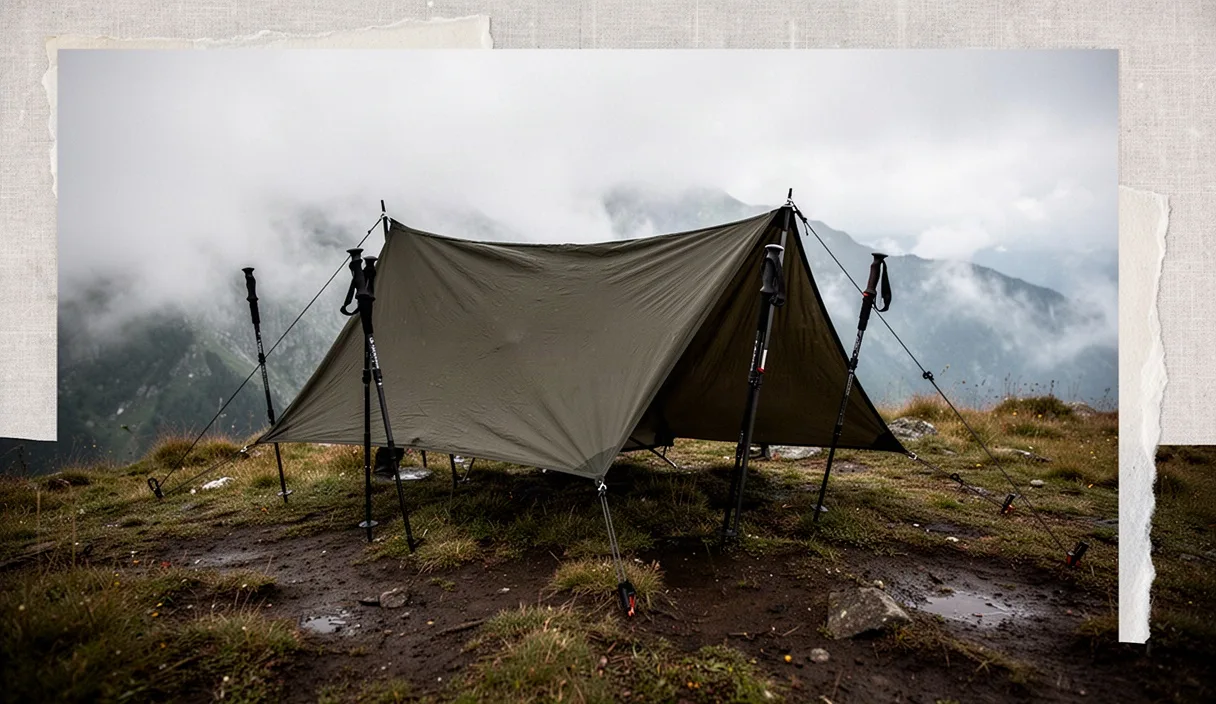
Rigid pitch geometry wins against mountain storms. A flat seven-foot by nine-foot rectangle gives you six distinct shelter setups using two adjustable trekking poles and eight ground stakes. Practice these three fastpacking pitches until you can build them in less than three minutes in the dark.
The Low A-Frame for High Winds
Position the spine perpendicular to prevailing winds. Stake down the two upwind corners directly to the earth with no guyline extension. Set your rear trekking pole to eighty centimeters and anchor the rear ridge line. Set your front trekking pole to ninety centimeters. Stake out the downwind corners with six inches of cordage to leave a low venting gap. This pitch keeps your profile under thirty inches, shedding fifty-mile-per-hour gusts while preventing wind from grabbing the underside of the fabric.
The Flying V or Lean-To for Fair Weather
Use this configuration when temperatures are mild and wind is predictable. Stake the back edge of the nine-foot side flat against the terrain with three stakes. Prop the front edge up with two poles set to one hundred and twenty centimeters. Pull the three front guylines taut to ground stakes positioned four feet forward. This creates a wide, sloping awning that traps heat reflected from rock walls while maximizing open-air airflow and view.
The Modified Half-Pyramid for Shifting Storms
Stake the two rear corners and the center-back tie-out flat to the dirt. Place a single trekking pole set to one hundred and fifteen centimeters dead center, roughly three feet back from the front opening. Pull the front corners down toward the ground at forty-five-degree angles and stake them tight. This creates a three-sided enclosure that shuts out crosswinds and driving sleet while leaving a protected front entrance for gear staging.
Managing Flying Insects and Wet Ground Crawlers
Creeping insects and biting flies will break your sleep faster than cold rain. Low elevations, boggy creek bottoms, and summer alpine meadows bring clouds of mosquitoes, midges, and black flies. Your shelter must keep them off your skin without cooking you in your sleeping bag.
A bivy excels here. Most technical fastpacking bivies feature a dual-closure system: an outer waterproof membrane and an inner superfine no-see-um mesh panel. You can zip the waterproof hood completely back and sleep under open sky while remaining protected from ticks, spiders, beetles, and mosquitoes. The integrated floor keeps damp ground moisture and slug trails completely separated from your sleeping pad.
A tarp requires an auxiliary system to stop insects. Running a bare tarp in mosquito season means adding gear, which chips away at your weight savings. Review the protective weights and limitations below:
- Standalone Bug Bivy: A mesh bivy sack with a waterproof 20D nylon bathtub floor weighs six to eight ounces. Combined with a flat tarp, it creates a flexible double-wall shelter weighing roughly eighteen ounces total. This matches a waterproof bivy in weight while providing vastly superior ventilation and dry sit-up space.
- Head Net and Sleep Shell: Weighs under one ounce. Wear a wide-brim running cap, drape the no-see-um head net over your face, and wear your rain jacket and wind pants inside the quilt. This eliminates shelter weight entirely, but midges can bite through thin running tights pressed tight against your hips.
- Perimeter Netting: Some runners sew an eight-inch strip of ultralight mesh along the entire outer edge of a tarp to drop down against the ground. This stops crawling bugs when weighted with rocks, but does not block flying bugs entering from open front pitches.
Site Selection Limits on Exposed Terrain
Natural features dictate whether a tarp or a bivy keeps you alive above treeline. In fell fields, ridgelines, and high alpine scree, soil depth is often less than two inches. Guyline stakes will pull out under tension when driven into loose scree or fractured shale. If you cannot anchor your tarp, you cannot pitch it.
Tarps demand precise terrain. You must find stable ground with sufficient friction to hold stakes, or hunt for anchor boulders weighing fifteen pounds or more to tie off guylines using the big-rock-little-rock method. You also need a micro-depression that provides relief from high winds without channeling surface runoff straight into your sleeping area. If an alpine thunderstorm blows up at two in the morning, a tarp pitched across a natural drainage swale becomes an active creek bed.
Bivies disregard terrain limits. A bivy sack needs a flat shelf measuring only two feet wide by six feet long. You can tuck yourself into a shallow rock trench, behind a sheep wall, on a narrow ledge, or between boulder clusters where pitching a tarp is physically impossible. You need no stakes; your own body weight pins the shelter to the ground. In emergency retreats where lightning or exhaustion forces an immediate halt on an exposed saddle, a bivy deploys in sixty seconds: roll out the pad, slide the quilt inside, crawl in, and secure the zipper.
Common Mistakes
- Pitching a tarp too high in wet wind: Raising poles above one hundred centimeters in driving rain invites cross-spray under the edges. Keep pitches low to the deck when air is moving.
- Using smooth titanium wire stakes in scree: Ultralight wire stakes have zero holding power in loose gravel. Carry at least four Y-beam aluminum or carbon stakes for high-load corner tie-outs.
- Closing the bivy hood completely without airflow: Zipping an unvented bivy entirely shut causes carbon dioxide buildup and soaks insulation with breath moisture in less than three hours.
- Forgetting a groundsheet with a tarp: Pitching a flat tarp directly over wet marsh or sod without a 0.7 mil polycro or Tyvek groundsheet lets ground moisture evaporate straight up into your down quilt.
- Over-tensioning DCF tarps: Dyneema Composite Fabric has zero stretch. If you yard on the guyline adjusters with the same force used on silnylon, you will rip corner tie-outs or pull stakes clean out of the soil.
Next Steps for Fastpackers
Dialing in your shelter system requires testing under controlled conditions before committing to a multi-day mountain traverse. Do not test a new tarp pitch or single-wall bivy for the first time during an unsupported ridgeline attempt.
First, test your bivy inside your backyard or a local park during an active rainstorm. Monitor how quickly condensation develops near the footbox, and confirm whether your sleeping pad fits inside without compressing the loft of your quilt against the side walls. If your feet touch the bivy fabric, down will wet out within four hours of continuous rain.
Second, take your flat tarp and practice the low A-frame and modified half-pyramid pitches using your actual running poles. Time yourself. If it takes longer than four minutes to set up a taut, wind-resistant pitch, adjust your guyline lengths, swap your line tensioners, or practice your trucker hitch knots. For deep wilderness routes with high storm exposure, consult local backcountry ranger stations regarding specific soil compositions and wind patterns before finalizing your sleep kit.