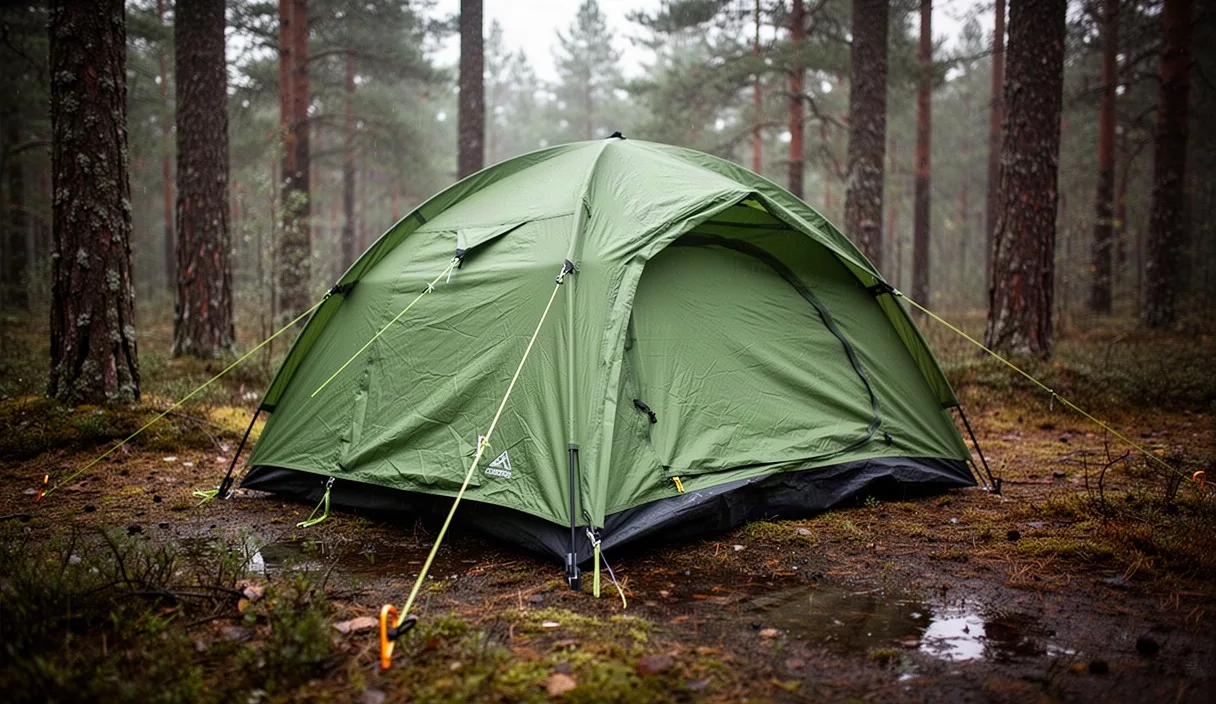
Ground draws heat four times faster than ambient air of the same temperature. When you sleep directly on frozen ground, snowpack, or bare granite, conductive heat loss pulls thermal energy straight out of your body via direct physical contact. A sleeping bag cannot stop this transfer on its own. Your body weight crushes down clusters and synthetic fibers flat beneath your hips and shoulders, eliminating the dead air spaces that trap warmth.
The sleeping pad serves as your primary thermal barrier in sub-zero terrain. Pad performance is measured by R-value, an objective engineering metric quantifying resistance to heat flow. Selecting the wrong pad configuration compromises your core temperature, causes shivering fits, and ruins sleep quality. In serious backcountry conditions, poor ground insulation can push your core toward hypothermia, which requires immediate medical intervention. Understanding how R-values function in the field keeps you warm and safe on frozen routes.
How Conductive Ground Heat Loss Drains Body Warmth
Thermal conduction happens when kinetic energy transfers between directly touching materials. Granite has a thermal conductivity between 1.7 and 3.98 Watts per meter-Kelvin. Compacted snow measures between 0.11 and 0.45 Watts per meter-Kelvin, while standing air measures roughly 0.024 Watts per meter-Kelvin. Frozen rock drains heat nearly 100 times faster than still air. If you lie on that surface with only compressed fabric between you, your body acts as a furnace trying to heat the entire planet beneath your tent floor.
Body weight compresses typical high-loft sleeping bag insulation down to a thickness of two to four millimeters under the pelvis, shoulder blades, and heels. At that compression, a sleeping bag that carries a comfort rating of -20 degrees Celsius provides an effective insulation level below R-0.4 underneath pressure points. The loft survives on top and sides, but the bottom becomes functionally inert.
Cold ground creates a steep temperature gradient across your sleep system. If your skin is 32 degrees Celsius and the frozen dirt beneath the shelter floor is -8 degrees Celsius, the 40-degree differential forces continuous conductive transfer. Without sufficient pad thickness and internal thermal resistance, you will wake up repeatedly with cold hips, stiff gluteal muscles, and shivering tremors. The metabolic cost of involuntary shivering burns up to 400 calories per hour, draining muscle glycogen reserves needed for the next day of travel.
Understanding the Standardized ASTM F3340-18 Rating
Before 2019, manufacturers used internal, non-standardized testing methods to calculate R-values. One brand's R-3.0 pad often slept colder than another brand's R-2.0 pad. The American Society for Testing and Materials established the ASTM F3340-18 standard to fix this discrepancy, creating a repeatable, laboratory-grade testing method across all brands.
The ASTM F3340-18 test places the inflated pad between two flat metal plates inside an environmentally controlled chamber. The bottom plate sits at a fixed cold temperature of 5 degrees Celsius. The top plate maintains a constant human body temperature of 35 degrees Celsius. Heat sensors measure how much electrical power the top plate consumes to maintain its target temperature. Less energy consumption indicates a higher thermal resistance, resulting in a higher standardized R-value.
| ASTM R-Value Range | Target Ground Temperature | Recommended Field Conditions | Average Pad Weight Range |
|---|---|---|---|
| 1.0 to 1.9 | Above 12 degrees C | Warm summer camping, dry conditions | 280 g to 410 g |
| 2.0 to 3.4 | 0 to 11 degrees C | Late spring to early autumn, mild ground frost | 340 g to 520 g |
| 3.5 to 4.9 | -6 to -1 degrees C | Shoulder season freezes, light early-season snow | 430 g to 680 g |
| 5.0 to 6.9 | -18 to -7 degrees C | Mid-winter conditions, deep snowpack, frozen mud | 540 g to 920 g |
| 7.0 and above | Below -18 degrees C | Polar environments, high-altitude mountaineering | 850 g to 1350 g |
ASTM R-values are directly linear. A pad with an R-value of 6.0 provides twice the conductive resistance of an R-3.0 pad. For any trip where night temperatures fall below freezing, an ASTM rating of 4.5 represents the baseline threshold for reliable warmth. If you are sleeping directly on glacial ice, frozen marsh, or compacted hardpack snow, push your target rating to 6.0 or higher.
Stacking Closed-Cell Foam with Inflatable Air Mats
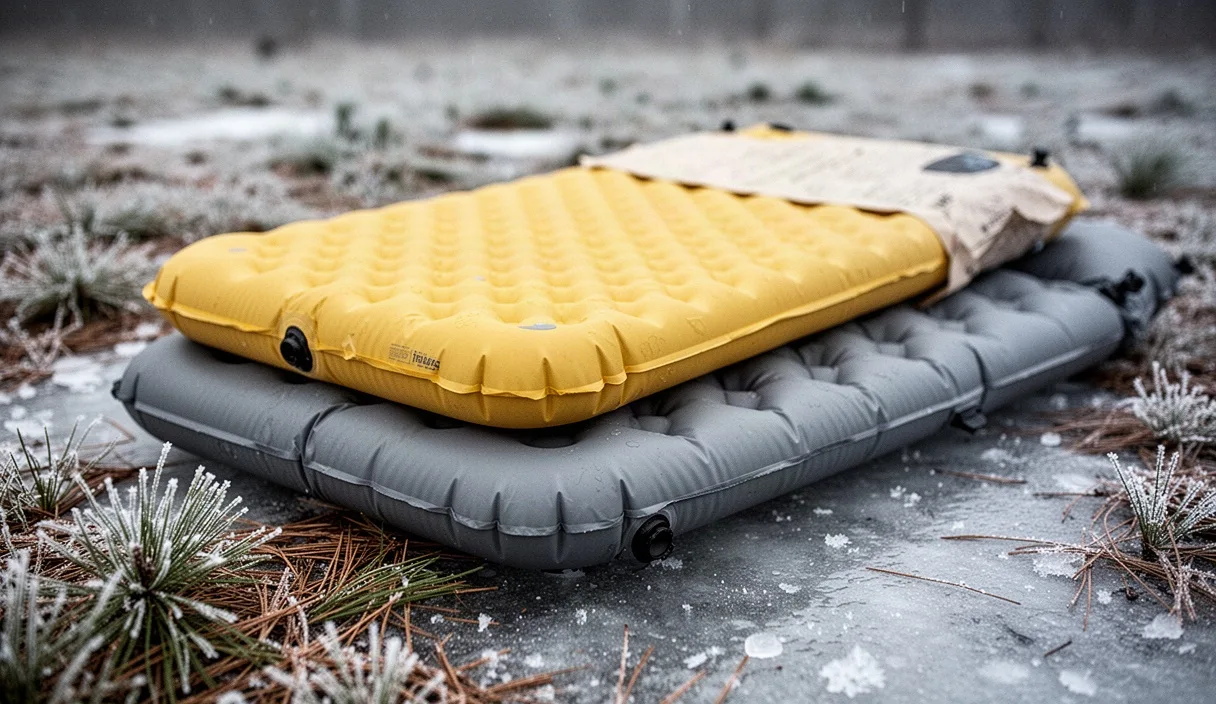
Stacking a closed-cell foam pad underneath an inflatable mattress is the standard technique for deep-winter expeditions. R-values are additive under the ASTM standard. Combining an ultralight closed-cell foam mat rated at R-2.1 with a three-season inflatable air pad rated at R-3.8 gives you an integrated winter sleeping system rated at R-5.9.
Pad sequence matters for durability and insulation stability. Place the closed-cell foam pad directly on the tent floor or snow, with the inflatable pad placed directly on top:
- Puncture protection: Frozen pine needles, sharp snow crystals, and jagged rocks cannot pierce a solid foam slab. Placing the foam pad on the bottom guards the vulnerable thermoplastic polyurethane fabric of the inflatable pad.
- Convective deceleration: The cold ground chills the bottom surface of an air pad first. The foam barrier stops the air inside the inflatable mattress from cooling as quickly, maintaining higher core air temperatures within the baffles.
- Reflective foam orientation: If the closed-cell foam pad features a silver aluminized film, face the silver side toward the inflatable pad to bounce radiant energy back into the mattress chamber.
A closed-cell foam pad also acts as an emergency failsafe. If an inflatable mattress punctures, tears along a seam, or suffers a terminal valve failure at 3:00 AM, the air pad deflates to R-0.0. The foam mat beneath it preserves a minimum baseline of thermal resistance, stopping rapid heat loss and keeping you off the freezing ground until daybreak.
Internal Reflective Films versus Synthetic Baffles
Inflatable pads must eliminate two problems: radiative heat loss downward and internal air convection. In an empty, uninsulated air mattress, the air warmed by your torso rises, while the cold air from the bottom falls. This internal convection loop pulls heat from your skin and dumps it directly into the ground. Manufacturers use two main interior technologies to stop this movement.
Reflective Film Construction
Reflective film systems use thin, suspended metallic sheets hung within horizontal or triangular baffles. These micro-thin aluminized layers reflect radiant infrared energy back toward your sleeping bag while dividing the internal cavity into multiple thermal layers to disrupt convective air loops. Therm-a-Rest uses this design in its NeoAir series with proprietary multi-layer matrices.
- Weight-to-warmth ratio: Highly efficient. An R-7.3 pad with multiple films can weigh under 490 grams.
- Packed volume: Compresses down to roughly the size of a 1-liter water bottle because the films are fractions of a millimeter thick.
- Acoustic noise: Early iterations produced a loud crinkling noise when moving, though newer designs have reduced this crackle significantly.
Synthetic Fiber Baffles
Synthetic insulated pads bond continuous-filament polyester batting (such as PrimaLoft or proprietary microfiber fills) directly to the upper and lower inner walls of the air chambers. These tiny fibers trap air molecules in place, eliminating internal convective circulation currents entirely. Exped and Sea to Summit frequently utilize this approach.
- Comfort and feel: Synthetic-filled pads are quiet to sleep on, with zero metallic crinkle during movement.
- Weight penalty: Slightly heavier than reflective film pads of equivalent thermal rating, typically adding 120 to 220 grams.
- Packing profile: Bulkier when rolled, requiring approximately 25 to 35 percent more pack volume than film designs.
| Feature | Reflective Film Design | Synthetic Baffled Design |
|---|---|---|
| Warmth-to-weight ratio | Very high (up to R-7.3 at sub-500g) | Moderate (R-5.0 at roughly 650g) |
| Packed size | Compact cylinder | Medium cylinder |
| Noise level | Audible crinkle on movement | Silent to near-silent |
| Durability impact | Films do not degrade if wet | Moisture can mat internal fibers over time |
Preventing Moisture Buildup from Breath Inflation
Do not inflate cold-weather air pads with your mouth. Human exhalation contains high humidity levels, carrying roughly 0.4 to 0.8 grams of water vapor per deep breath. Inflating a high-volume winter mattress requires between 20 and 35 full lung exhalations, pumping liquid vapor straight into the pad's sealed internal cavity.
In sub-freezing base camps, that exhaled vapor condenses on the cold interior baffle walls and freezes into ice crystals. This process leads to three distinct gear problems:
- Thermal degradation: Accumulated ice conducts heat faster than dry air, lowering the pad's functional R-value over multi-day trips.
- Internal delamination: Ice crystals have sharp edges that can scratch delicate interior reflective films or shred glued baffle joints when you roll the pad tight in the morning.
- Internal mold growth: When the pad returns to room temperature at home, the melted ice pools inside the sealed mattress, creating an optimal environment for mold and mildew that degrades synthetic laminates.
Use a dedicated roll-top pump sack or an ultralight battery pump to fill the pad. Follow these steps to operate a pump sack efficiently in deep cold:
- Seat the valve: Snap the pump sack nozzle firmly onto the pad's intake valve before opening the collection collar. Make sure no snow clings to the interface.
- Capture ambient air: Open the pump sack mouth wide, hold it 30 centimeters from your face, and give one gentle, short breath from distance to initiate air flow, or simply scoop ambient shelter air into the bag.
- Seal and compress: Roll the stiffened collar over twice, trap the captured air bubble with your arms, and lean down smoothly to push dry, ambient air into the mattress chambers.
- Clear the valve before closing: Once the pad reaches proper firmness, disconnect the pump sack immediately and cap the intake valve to block outside moisture and loose snow crystals.
Common Mistakes
- Bottoming out the mattress: Deflating a pad slightly to make it softer often drops your hip bone through the air cushion to touch the ground. That eliminates the air barrier at your heaviest point. Keep winter pads inflated firmly.
- Using non-standardized pad ratings: Assuming an unverified R-4 rating from a bargain manufacturer matches an ASTM F3340-18 verified pad. Always verify the formal ASTM standard label on the packaging.
- Leaving pads inflated in direct sunlight: Winter sunlight reflected off snow can overheat a sealed pad left in a tent, causing air inside to expand and burst the internal baffle welds. Vent your valves during daytime rest stops.
- Storing pads rolled tightly while damp: Leaving a winter pad rolled inside its stuff sack between trips locks trapped moisture against synthetic batting, causing fiber rot and unpleasant odors.
- Relying on a summer air pad on snow: Pairing a -30 degree sleeping bag with an R-1.5 pad will leave you shivering. Down bag temperature ratings assume the user rests on a sufficiently insulated pad; without it, the system fails.
Winter Pad Selection and Care Next Steps
Audit your current sleep system before setting out in freezing conditions. Lay out your primary air pad and check the technical specifications printed on the storage sack or near the inflation valve for the ASTM F3340-18 icon. If the pad uses an older, non-standard rating, deduct roughly 20 percent from its stated value to estimate its true thermal resistance.
If your cold-weather itinerary expects ground temperatures below -5 degrees Celsius, invest in a 1.5 to 2.0-centimeter closed-cell accordion foam pad to stack beneath your existing primary mat. This simple, reliable addition instantly boosts your system by R-2.0, protects against sharp surface hazards, and gives you a durable seat for cooking outside the tent. After every winter outing, unroll your inflatable pad at home, open all valves fully, and let dry ambient indoor air circulate through the chambers for at least 72 hours before long-term storage.